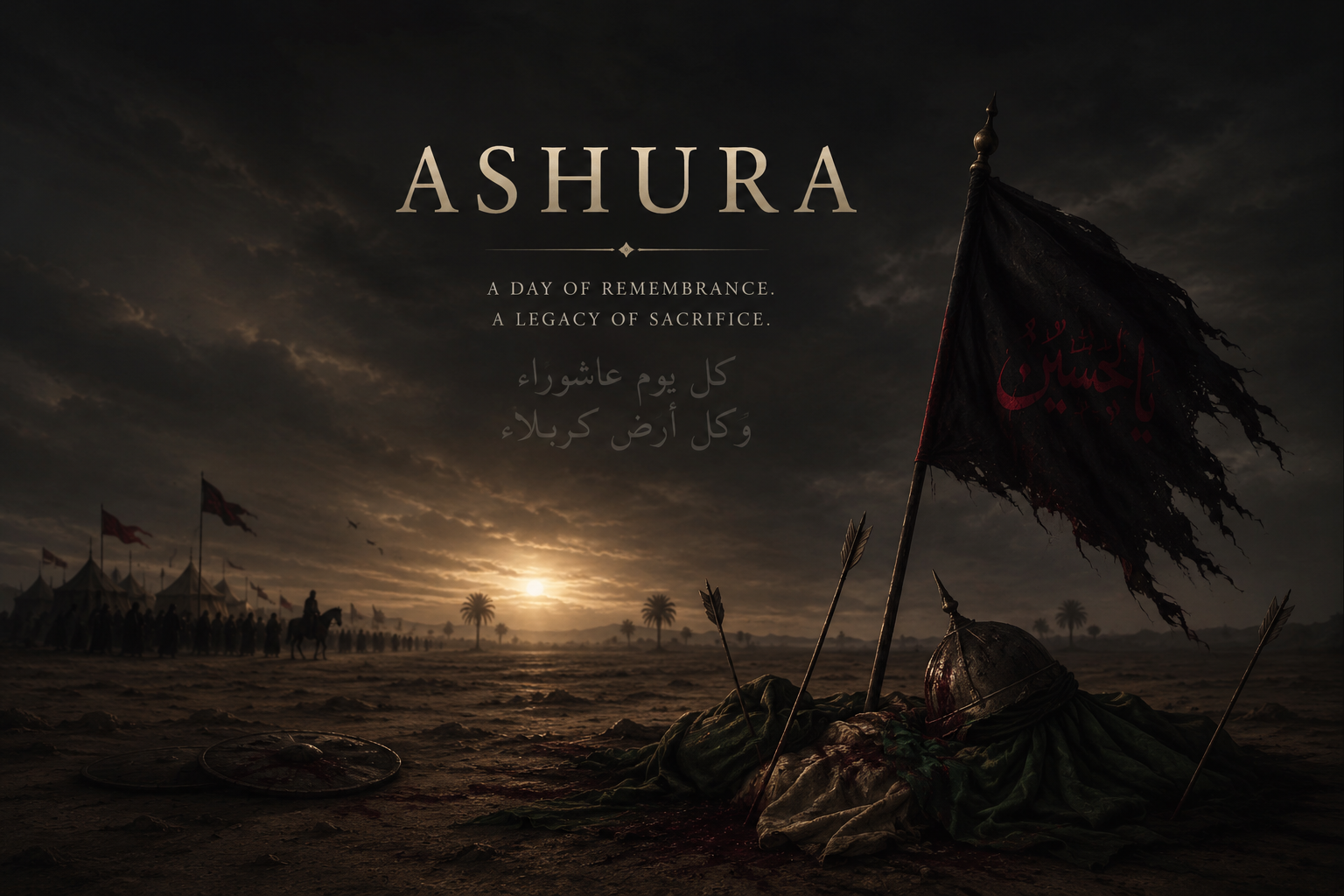
A remembrance of the stand of Imam Husayn (peace be upon him) at Karbala, and of the Fourteen Infallibles — the Prophet, his daughter Fatima, and the Twelve Imams — who carried the message of justice, patience, and faith.
What is Ashura?
Ashura is the tenth day of Muharram, the first month of the Islamic calendar. It marks the day in 61 AH (680 CE) when Imam Husayn ibn Ali (peace be upon him), the grandson of the Prophet Muhammad, was martyred on the plain of Karbala in Iraq.
Refusing to pledge allegiance to the tyranny of Yazid, Husayn left Medina with his family and a small band of loyal companions. They were surrounded at Karbala and cut off from the waters of the Euphrates.
Karbala was a military defeat but a moral victory that has echoed for fourteen centuries — the eternal symbol of standing for truth against tyranny, whatever the cost.
The Days of Karbala
Arrival at Karbala
Husayn’s caravan reaches the plain of Karbala and makes camp.
Water cut off
The army blocks access to the Euphrates; the camp endures thirst.
The camp surrounded
The army closes in; Husayn asks for one night for prayer.
The martyrdom
Husayn and his companions are martyred; the tents are set ablaze.
The captives
The women and children are taken captive toward Kufa, then Damascus.
The fortieth day
Forty days after Ashura, mourners gather at Karbala — among the largest gatherings on earth.
The Fourteen Infallibles
The Prophet Muhammad (peace be upon him and his family)
The Prophet of Islam, grandfather of Hasan and Husayn, from whose household the Imams descend.
Further reading →Fatima al-Zahra (a)
Daughter of the Prophet, wife of Imam Ali, and mother of Hasan, Husayn and Zaynab.
Further reading →Imam Ali ibn Abi Talib (a)
Cousin and son-in-law of the Prophet, the first male to embrace Islam.
Further reading →Imam Hasan al-Mujtaba (a)
Eldest grandson of the Prophet, known for forbearance and generosity.
Further reading →Imam al-Husayn (a)
The Master of Martyrs, who stood against tyranny and was martyred at Karbala on Ashura.
Further reading →Imam Ali Zayn al-Abidin (a)
Survivor of Karbala, author of the Sahifa al-Sajjadiyya supplications.
Further reading →Imam Muhammad al-Baqir (a)
“He who splits knowledge open,” a great teacher of the Prophet’s sciences.
Further reading →Imam Ja’far al-Sadiq (a)
Founder of the Ja’fari school; thousands of scholars studied under him.
Further reading →Imam Musa al-Kazim (a)
“The one who restrains his anger,” who spent long years imprisoned.
Further reading →Imam Ali al-Rida (a)
Brought into the Abbasid court as heir apparent; his shrine in Mashhad is among the holiest.
Further reading →Imam Muhammad al-Jawad (a)
Became Imam as a young child, a sign of God-given knowledge; known for generosity.
Further reading →Imam Ali al-Hadi (a)
Lived under close watch in Samarra, devoted to worship and knowledge.
Further reading →Imam Hasan al-Askari (a)
Father of the awaited Imam, who lived under house arrest in Samarra.
Further reading →Imam Muhammad al-Mahdi (a)
The awaited twelfth Imam, living in occultation, whose return will fill the earth with justice.
Further reading →How Ashura is Commemorated
Majalis & Recitation
Gatherings where the story of Karbala is narrated and elegies recited, moving hearts to tears.
Processions
On Ashura mourners process through the streets in black, beating their chests in shared grief and protest against oppression.
Arba’een Pilgrimage
Forty days after Ashura, millions walk to Karbala — one of the largest peaceful gatherings on earth.
Charity & Service
Free food and water are offered to all, honouring the thirst of Karbala with generosity.
Lessons of Karbala
Above mourning, Ashura is a school of dignity, courage, patience, and justice.
Ten Days of Muharram
The first ten nights of Muharram build toward Ashura, each recalling a chapter of the journey to Karbala.